

Can You Read a Stitch?
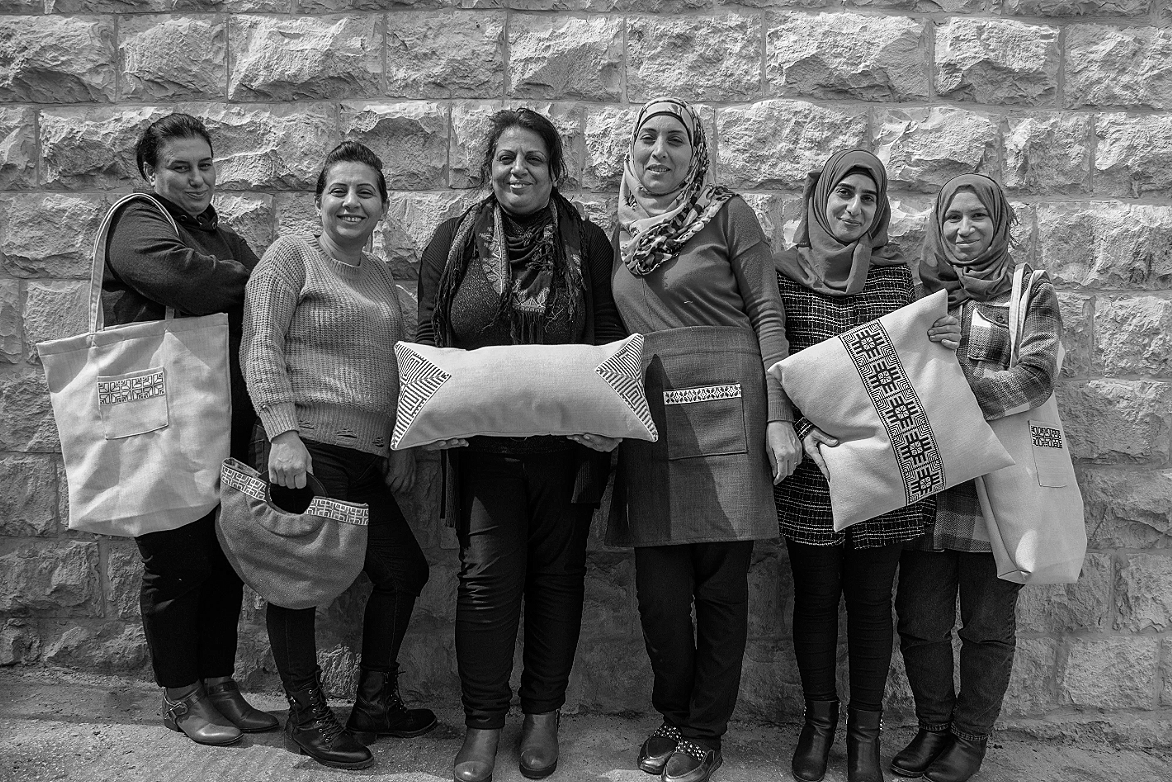
Palestine, Tatreez and the language hidden inside motifs.
One World, Different Threads | Chapter 01: Palestine
Look at a piece of Tatreez and you might first see a pattern.
A flower.
A tree.
A diamond.
A series of carefully counted stitches.
But look a little closer and there can be much more there.
A place.
A landscape.
A memory.
A woman's story.
Perhaps even home.
Because Palestinian embroidery was never simply about making something beautiful.
For generations, women stitched patterns into their clothing that could carry information about where they came from and the communities to which they belonged. Different regions developed distinctive styles, colours, arrangements and motifs.
In a way, you could read the stitches.
And that is where we begin our first journey in One World, Different Threads.
A language made with thread
Tatreez, is most closely associated today with the intricate cross-stitch embroidery found on traditional Palestinian dress.
Historically, however, there wasn't one single Palestinian style. Ramallah did not necessarily stitch like Bethlehem. The embroidery of the southern coastal region could look different again. Individual villages and communities developed their own combinations of motifs, colours, materials and ways of arranging embroidery.
A woman's clothing could therefore say something about where she was from before she had said a word. It could also reveal aspects of her life. Her clothing might change with marriage, motherhood, mourning, economic circumstances or simply changing fashions. The thobe, the traditional dress, became something remarkably personal: clothing, yes, but also something closer to a biography written in cloth.
The stories hidden inside the motifs
This is where our own journey with Tatreez becomes particularly interesting.
Through our collaboration with Darzah, a Palestinian social enterprise working with women embroiderers in Palestine, we've begun exploring traditional motifs and the extraordinary knowledge that sits behind them. What initially appears to be a beautiful arrangement of geometric shapes can lead us somewhere entirely different.
To a landscape. A village. A journey. Or a way of life.
Take the Cypress Tree, known as Sarw.
The cypress appears in different forms across Palestinian embroidery, including variations associated with Gaza, Jaffa, Ramallah, Hebron and Bir al-Saba. One tree. Many interpretations. The shape may be recognisable, yet the way it is stitched changes from one place to another. Perhaps that is one of the most beautiful things about a living tradition. A familiar form can carry the identity of a place without losing the individuality of the person stitching it.
Then there is Road to Egypt, or Tareeq Masr.
Even the name invites curiosity. A road to where? Who travelled it? What connected these places? The motif has been documented on historic Palestinian garments, including a dress from Yibna dating to the 1930s. Its name has prompted interpretations connecting it to Egypt and historic routes of travel and exchange, although its precise origins are not firmly established. We find that fascinating.
Because embroidery doesn't exist separately from the world around it. It can reflect landscapes, movement, encounters and the everyday experiences of the people creating it. Other motifs we are exploring include Seeds or Grains, Diamond with Rosette and Horn Quadrants, associated in our design references with the Ramallah region. Their names alone make us want to ask more questions.
What inspired these shapes? How did they acquire their names? Were their meanings understood in the same way across generations? How did their arrangements change between communities? We don't want to invent answers where history is more complicated. We want to discover them through the people who know these traditions, through historic garments and archives, and through conversations with the women continuing to stitch them today.
Because the beauty of Tatreez isn't only in knowing the name of a pattern. It's in discovering the world that existed around it. And understanding how that world continues to find expression through thread. The landscape found its way into the cloth. Perhaps it shouldn't be surprising that so many traditional motifs draw inspiration from the natural world. Much of historic Palestinian life was closely connected to the land and agriculture, and the natural environment found its way into embroidery. Trees. Flowers. Leaves. Birds.
Forms from everyday surroundings became patterns that could be repeated and passed from one generation to another. But what makes this particularly interesting is that these patterns were not necessarily fixed. A motif could be recognised across different communities while appearing in different colours, arrangements and variations.
The maker was still present.
Her choice of colour.
Her arrangement.
Her skill.
Her interpretation.
Her stitch.
That makes Tatreez feel less like a fixed design system and more like a language with different dialects and individual voices. A daughter could learn something from her mother or grandmother and still leave something of herself within it. And then teach someone else.
Knowledge passed from woman to woman
For much of its history, Tatreez wasn't learnt by opening a book or searching for a pattern online. Knowledge travelled between people. Women embroidered together. Girls learnt from mothers and grandmothers. Patterns, stitches and techniques moved through families and communities. That makes the embroidery itself only one part of the tradition. The act of teaching is part of it too.
So is sitting together.
Watching.
Repeating.
Making mistakes.
Learning how many stitches belong here and where the next colour begins.
Eventually, knowledge that once belonged to somebody else becomes knowledge held within your own hands. And perhaps that is one of the most extraordinary things about making traditions. They survive because somebody takes the time to teach, and somebody else takes the time to learn.
Then the map changed
But what happens to a visual language so closely connected to place when people are separated from those places? This is where the story of Tatreez becomes more complicated. The mass displacement of Palestinians during the Nakba in 1948 transformed Palestinian life, and Palestinian embroidery changed with it. Women from different villages and regions found themselves living alongside one another. Patterns travelled. Techniques met. Designs that had once communicated very local identities began to circulate beyond those places.
Over time, Tatreez increasingly became associated not only with a particular village or region, but with a wider Palestinian identity. The language changed. But it didn't disappear. In some ways, the thread began carrying something even bigger. Memory of place. Memory of home. And a way of saying: We are still here.
Can a stitch remember a place?
That question has stayed with us while developing this series. If a woman learns a motif in one village and teaches it to her daughter somewhere else, where does that motif belong? If the granddaughter has never lived in the place where the pattern originated, but knows how to stitch it because her grandmother taught her, has the tradition moved? Or has a small piece of that place travelled with her?
There probably isn't one simple answer. But perhaps that's precisely why embroidery matters. Heritage doesn't always need to remain physically where it began in order to survive. Sometimes it travels in language. Sometimes in food. Sometimes in music. And sometimes in the memory of someone's hands.
A living tradition
It would be easy to end the story of Tatreez by talking only about preservation. We don't want to do that. Because Tatreez isn't simply something belonging to the past. Women continue to embroider. Designers continue to interpret it. Artisans continue to teach it. New generations continue to learn it. And importantly to us at YA SOKO, embroidery can still create an opportunity to earn.
That matters. Because if we genuinely value a traditional skill, perhaps preservation shouldn't only mean putting an old garment behind glass. It should also mean valuing the knowledge required to make it. Paying people properly for that knowledge. Creating opportunities for the skill to remain useful. And allowing traditions to evolve without forgetting where they came from.
Through our work with Darzah, we've seen how traditional embroidery can become part of contemporary design, connecting skills passed through generations with new products and new markets. A motif that once appeared on a traditional garment can find its way onto something designed for everyday life today. Its form may be familiar. Its surroundings may be entirely different. But the skill required to create it remains. And behind that skill is a person whose time, knowledge and expertise deserve to be valued. Because the women stitching today aren't simply reproducing history.
They are becoming part of it.
So, can you read a stitch?
Maybe not yet.
We certainly still have a great deal to learn. And that's exactly the point of this series. We want to understand the motifs more deeply. Where they came from. Why particular patterns appeared in particular places. What they mean to the people stitching them today. Most importantly, we want to hear from the people who actually hold this knowledge.
Because One World, Different Threads isn't about us trying to speak for traditions that aren't ours.
It's about asking questions. Listening. Learning. And sharing what the people behind the thread choose to tell us.
Our first stop is Palestine. And already, one thing feels very clear. Sometimes a stitch isn't simply a stitch.
It can be a place.
A memory.
A livelihood.
A piece of knowledge passed between generations.
And sometimes, it can carry home with it wherever it goes.
One world. Different threads.
The journey continues.
